

Before you order your gate
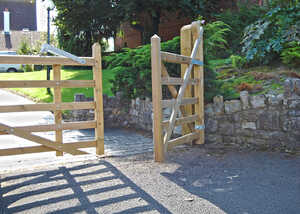
Before you order, decide how you want the gate to operate. This is usually determined by the location and the space you have to work with, so picture how the gate will swing, where it will sit when open, and how you will reach the catch.
If you are putting in new gate posts, it's advisable to have them installed first. Set them securely and let them settle before you take any measurements, because a post that shifts will throw off your sizing. Once the posts are in place, measure the distance between them at three positions: the top, the middle, and the bottom. Openings are rarely perfectly square, so always work from the smallest of the three measurements. That way the gate will fit even at its tightest point.
Hanging a gate on the face or back of the post
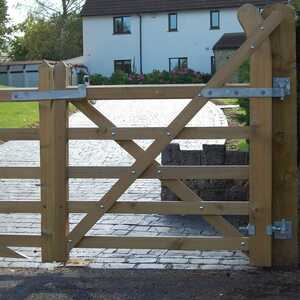
One common method is to hang the gate on the back or front face of the post rather than within the opening. When you do this, position the hinge pin in the centre of the post to give the fixing maximum strength. The gate then overlaps the post, and the amount of overlap you need depends on the post size you are using. The larger the post, the greater the overlap.
| Post size | Overlap |
| 150 x 150mm | 25mm overlap |
| 175 x 175mm | 37.5mm overlap |
| 200 x 200mm | 50 mm overlap |
Once you know your overlap, you can work out the gate size you need...
For a single gate
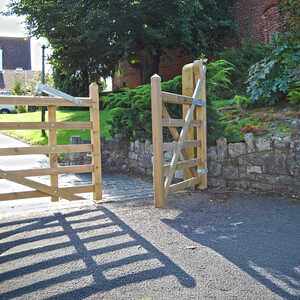
Measure the distance between your posts and add the overlap for each post. Using the 50mm overlap for a 200 x 200mm post as an example, your required gate size would be the distance between the posts, plus 50mm, plus 50mm.
For a pair of gates
The method is much the same. Measure the distance between the posts, add the overlap for each post, then take off 15mm to allow for the gap where the two gates meet in the middle. If both gates are the same size, divide the total by 2 to get each gate's size. For a pair of different sizes, split the total to suit your layout.
Written as a calculation, that is the distance between the posts, plus the overlap for each post, minus a 15mm allowance for the central gap, which gives your total measurement. Divide that total by 2 to determine the size of each matching gate.
Hanging a gate between the posts
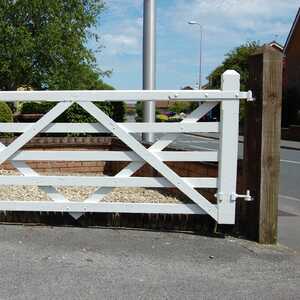
The other option is to hang the gate within the opening, between the two posts. As with the previous method, keep the hinge pin in the centre of the post to maximise strength.
To size a gate hung this way, measure the distance between your posts, then take off the gap needed for your hinge on one side and your catch on the other. Those gaps vary depending on the specific hinge and closing fitting you choose, so use the figures below as your guide.
| Double strap hinge set | 120mm gap |
| Field gate auto catch | 110mm gap |
| Bolt | 15 mm gap |
The double strap hinge set is the most popular choice for country-style gates. It comes in a range of sizes and finishes to suit different gates and settings, including our galvanised adjustable field gate set.
We offer alternative devices for field gates that will work with this layout, so please contact us for guidance and advice.
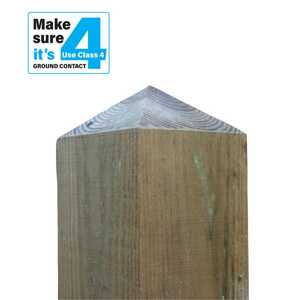
Choosing the right posts
Your posts carry the full weight of the gate every time it swings, so they need to be sized to the job. Our Use Class 4 timber gate posts come with a weathered four-way top and are available in a range of sizes. As a general rule, the longer and heavier the gate, the larger the post it needs.
| Gate length | Post size |
| 0.9m | 125 x125mm |
| 1.20 -1.50m | 150 x 150mm |
| 1.80 - 3.0m | 175 x 175mm |
| 3.0 – 4.80m | 200 x 200mm |
Whichever size you choose, install your posts to a minimum depth of 600mm, so they have sufficient anchorage to remain firm. One important point to remember: never shorten a post and place the cut end in the ground. Cutting through the treated surface exposes untreated timber, compromising the treatment's integrity and causing the post to fail quickly.

Selecting hinges and gate fittings
The right hinge keeps a gate hanging level and takes the strain off the joints over time. Match the hinge set to your gate's length using the guide below.
| Gate Length | Recommended Hinge |
| 0.90m | 300mm (12") Field Gate Hinge Set on Plates |
| 0.90 -1.80m | 460mm (18") Field Gate Hinge Sets |
| Over 1.80m | 600mm (24") Field Gate Hinge Sets |
The 460mm and 600mm field gate hinge sets are available as standard fixed or adjustable versions, and are supplied with hook-on plates as standard. Bolt-through-the-post fixings are also available.. For gates over 3.6m, we also recommend fitting a supporting gate wheel to reduce the stress on the gate joints as it swings. If you are hanging a pair of gates, adjustable field gate hinge sets are the sensible choice, sized to suit each gate as shown above, so you can fine-tune the alignment once they are up.
If you are gating a driveway or a wider entrance, our guide to selecting your driveway gate covers larger sizes and fittings in more detail.
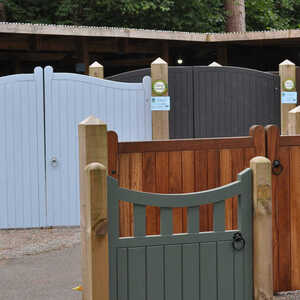
Caring for your gate
Wood is a natural material. Although pressure treatment guards it against rot and decay, timber will still take up moisture through the winter and dry out over the summer, causing it to expand and contract with the seasons. Left untreated on the surface, that movement can lead to cracking, twisting and swelling over time.
Applying a microporous, water-repellent paint or wood stain allows the timber to breathe, taking up and losing moisture at a slower, steadier rate. That keeps the movement gentle and helps your gate hold its shape and finish for longer. You will find suitable timber preservers and woodcare products in our range.
Thorndown Wood Paint and the Treatex Classic Colour Collection are both suitable options for exterior timber, offering a long-lasting, hard-wearing finish for gates, doors, fencing and other joinery. It is worth treating a new gate before it goes up, or soon after, and then keeping an eye on the finish each year.

Order your country-style gate from Fountain Timber
Our country-style gates are built to handle everyday use and the ever-unpredictable British weather; in softwood or hardwood to suit your budget and aesthetic preference. The Universal Gate is a versatile softwood gate that suits a wide range of properties and configurations.
The Entrance Gate offers the same traditional country style in pressure-treated softwood, while the Hardwood Entrance Gate gives you a premium hardwood finish for a standout entrance.
Because most of our gates are made to order, it is best to contact the office to discuss your sizes, hinge configuration, and lead time before you buy. You are also welcome to visit us at the yard in Backwell to see the timber and fittings for yourself and get advice from the team.
The information and advice in this article are provided in good faith and are intended as general guidance only. Any reliance you place on it is at your own risk. If you are in any doubt, we strongly recommend seeking professional assistance.
If you need further advice with your purchase, please ask our experienced staff, and we will be happy to help.
 Updating page...