

Choosing a driveway gate style
The right driveway gate will depend on the style of the property, the level of privacy required and the overall look you want to create at the entrance.
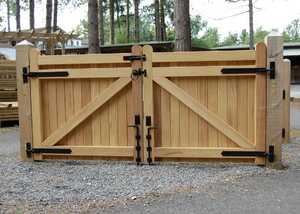
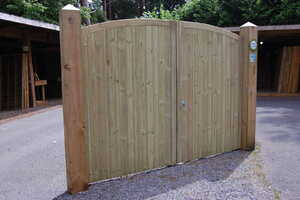
For a more enclosed entrance with added privacy, the Aberdeen Driveway Gates offer a strong, characterful design manufactured from treated softwood or selected hardwoods. A solid appearance makes them well-suited to homes where privacy is a key part of the brief.
The Stirling Driveway Gates also bring character and privacy, with high-quality handmade construction available in treated softwood or selected hardwoods. It's a style that works particularly well where the gate needs to feel substantial and in keeping with a traditional setting.
Natural timber, hardwearing, secure
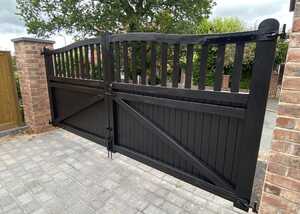
For an entrance with a lighter visual feel, the Banff Driveway Gates feature an open slatted top. This gives the gate a more decorative finish while still providing a sturdy construction suitable for traditional and modern properties.
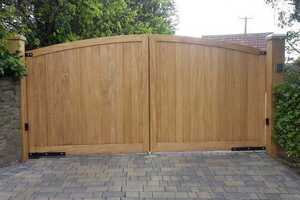
The Arbroath Driveway Gates offer a distinctive aesthetic with a beautiful curved slatted top and a sturdy framework designed for strength and durability; a good fit for properties where the driveway entrance needs a softer, more decorative profile.
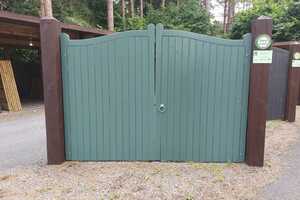
The Edinburgh Driveway Gates and Perth Driveway Gates both offer a handmade finish that can enhance a property's appearance without feeling overly heavy or enclosed. They are suited to entrances where the gate should add character while still allowing the surrounding setting to remain part of the view.
All Fountain Timber driveway gates are made to order to your specific requirements and are not available to purchase online. For prices and lead times, please call the office on 01934 862710 or complete the enquiry form on the relevant product page.

Timber driveway gate construction
Driveway gates need to be built with enough strength for their size, weight and exposure. A wide gate leaf places greater pressure on the frame, hinges, and posts, so the quality of the construction directly affects how well the gate performs over time.
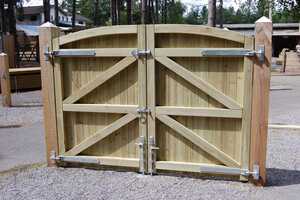
Fountain Timber’s driveway gates have been updated with stronger bracing for wide gates, with reinforced support available for wider leaves up to 2.4m. Flat-top designs also include additional top braces to help prevent twisting and warping.
The joints have been enhanced with metal star dowels for added strength and easier hinge installation. Boards now run to the bottom to reduce water retention points, while additional stainless steel nails support a long-lasting assembly; details that help the gate cope better with regular use, weather exposure, and the natural movement of timber.

How driveway gates should sit between posts
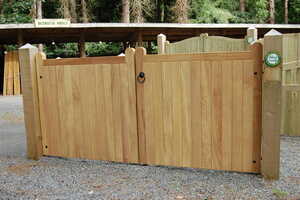
With driveway gates, it is advised that they sit between the posts, with the hinges fixed to the back face of the timber post. This creates a flush finish with minimal gaps, giving the entrance a neater and more secure appearance.
Every installation is different, and other installation methods may be possible depending on the site, posts, ground levels, opening direction, and hardware being used. Please check with your installer before ordering or fitting your gates.
Measuring for driveway gates
Accurate measuring is essential when ordering driveway gates, especially when fitting them between existing posts. Small measurement errors can affect hinge clearance, closing gaps and the final alignment of the gates.
If you are ordering a pair of gates to fit between existing posts, measure the distance from inside the post to inside the opposite post, then subtract 45mm for your hinge and closing gaps. This allows 15mm on each side and 15mm in the centre.
For a single gate, take 30mm off the measurement to allow for the hinge and closing gaps.
When measuring the width for your gates, take three separate measurements: one at the top, one in the middle and one at the bottom. Use the smallest measurement when placing your order. If there is a large discrepancy between the measurements, it may be best to reset the posts before ordering the gates.
If new posts are being installed, it is advisable to install them first. Once they are in place and secure, measure the distance between them before ordering your gates. This reduces the risk of ordering gates to suit an intended opening that may change slightly during post installation.
Suggested post dimensions for gate sizes
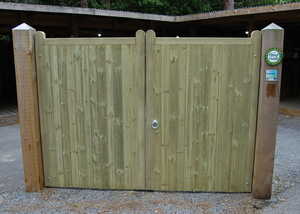
The post size should match the gate's width and weight. Wider gates need stronger posts to support the gate properly and reduce movement over time.
| Gate Width | Post size |
| 0.90m | 125 x125mm |
| 0.90-1.20m | 150 x 150mm |
| 1.20 -1.80m | 175 x 175mm |
| 1.80 – 2.40m | 200 x 200mm |
Important: never shorten a post and place the cut end in the ground. It will destroy the integrity of the treatment and cause the post to fail very quickly.
For larger driveway gates, suitable timber gate posts should be selected carefully as part of the overall installation. The gate, post, hinge and fitting choices all need to work together.
Hinges and gate fittings
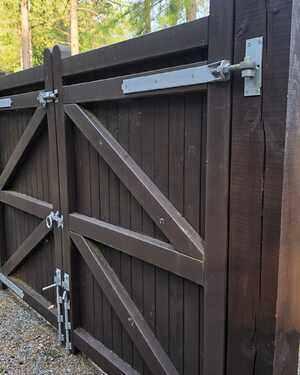
The correct hinge size helps support the weight of the gate and allows it to open and close properly. As gate width increases, the hinge size should increase too.
| Gate Width | Recommended Hinge |
| up to 1.20m | 460mm (18") Hook & Band Hinge Sets |
| 1.20 - 1.80m | 600mm (24") Hook & Band Hinge Sets |
| 1.80 -2.20m | 750mm (30") Hook & Band Hinge Sets |
| Over 2.20m | 900mm (36") Hook & Band Hinge Sets |
Fountain Timber stocks a range of gate hinges and latches to support driveway and garden gate installations. Hook and band hinges are a common choice for timber gates because they provide good support across the gate leaf, but the exact fitting should be chosen to suit the gate size, post type and installation method.
When hanging a pair of gates, precision is essential. Timber is a natural, organic substance affected by the environment, so it will expand and contract through the seasons. For this reason, it is highly recommended that adjustable hinges are used where possible to keep the gates in line.
If your gates are taller than 1.20m, it is advisable to fit a 150 x 16mm Brenton pad bolt near the top of the gate to prevent them from twisting out of line with each other.

Planning the installation
Before installation begins, consider how the gates will open, where the hinges will sit and whether the ground rises or falls across the swing of the gate. Uneven ground can affect clearance, especially on inward-opening or outward-opening pairs.
You should also think about access requirements. A driveway gate used several times a day will have different demands from one used occasionally. The gate needs enough clearance to open freely, close securely and avoid strain on the posts and hinges.
For pairs of driveway gates, both leaves need to meet cleanly in the centre. The closing gap should be allowed for at the measuring stage, and fittings such as drop bolts, tower bolts, pad bolts and locks should be selected to suit the intended use.
If automation is planned, speak to your installer before ordering. Automated gate systems may require specific clearances, reinforcement, posts or hardware, and these should be considered before the gate is manufactured.

Timber driveway gate after-care
Wood is a natural product and, although pressure treatment will protect it against rot and decay, timber will still absorb moisture in winter and dry out in summer. This causes it to expand and contract as the seasons change.
Finishing your gate with a high-quality exterior wood paint or opaque timber finish will help protect the surface while allowing the timber to respond more steadily to changing weather conditions. Products such as Thorndown Wood Paint and the Treatex Classic Colour Collection are both suitable options for exterior timber, offering a long-lasting, hard-wearing finish for gates, doors, fencing and other joinery. This helps reduce the risk of cracking, twisting or swelling as the timber absorbs and releases moisture through the seasons.
Regular care will also help preserve the gate's appearance and performance. Check hinges, bolts, and fittings periodically, particularly after heavy rain, frost, or prolonged dry weather. Clean off dirt, leaves and debris where they collect, as this can hold moisture against the timber.
If the finish begins to fade or wear off, reapply a suitable timber treatment in accordance with the product instructions. A consistent maintenance routine gives timber gates the best chance of performing well for years.


Need advice before choosing your gate?
The information and advice in this article is provided in good faith and is designed to give general information and guidance. Any reliance you place on such information is therefore strictly at your own risk. If in doubt, we strongly recommend that you seek professional assistance.
If you need further advice with your purchase, please ask our experienced staff. We will be happy to help.
 Updating page...