

What is the purpose of your fence?
Before looking at colours, finishes or decorative details, it helps to be clear about what your new fence needs to do. A fence used for privacy will usually need a very different structure from one used to mark a front garden boundary.
A fence designed to keep pets safely inside the garden will need to be secure at ground level, while a decorative screen around a seating area might call for something lighter and more open.
For many gardens, the answer may be a combination of styles. A tall, solid panel might work well along the back boundary, while a trellis could soften the sides of the garden and allow more light through. A low picket fence could define a front garden or pathway without making the space feel enclosed. Looking at each area of the garden separately can help you create a more considered result.
Choose solid fencing for privacy and security
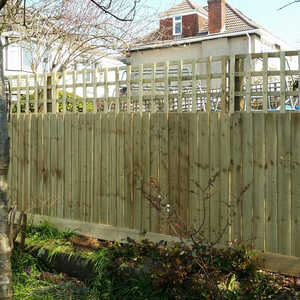
If privacy is high on your list of priorities, solid fencing will certainly provide the best coverage. Taller panels with minimal gaps help screen your garden from neighbouring properties, roads and footpaths, making them particularly useful around patios, lawns and family spaces.
Fountain Timber’s timber fence panels offer options for privacy, security, and visual appeal, with pressure-treated designs engineered to withstand outdoor conditions. Closeboard, feather edge, tongue and groove, overlap and decorative panels all offer different levels of screening, strength and finish.
A premium closeboard panel gives a strong, traditional appearance and works well for secure boundaries. Tongue-and-groove panels offer a more refined finish, with interlocking boards that create a neat, enclosed look. Overlap panels can suit larger fencing runs where value and coverage are key considerations.
For a fully boarded fence built on site, traditional featheredge fencing remains a long-standing favourite for homeowners. Built using individual featheredge boards, posts, rails, gravel boards, and capping, it creates a robust boundary that can be adapted to the garden's shape and length.

Consider picket fencing for softer boundaries
Not every fence needs to create a solid screen. In front gardens, cottage-style spaces and areas where visibility is useful, picket fencing can bring definition without closing the garden off.
Picket fencing works especially well for marking boundaries, edging lawns, framing pathways and separating planting areas. Its open structure allows views through the fence, which can make smaller gardens feel more spacious. It also brings a traditional finish that suits both residential and commercial properties.
Fountain Timber’s range includes individual pointed top and round top pickets, picket borders, cottage picket panels and matching gates. The products are pressure-treated for durability, making them suitable for long-term outdoor use. For homeowners who want a friendly, traditional boundary rather than a tall screen, picket fencing has a timeless appeal.

Use trellis where light and planting are important
Trellis is one of the most versatile fencing additions because it can be used in several ways. It can sit on top of fence panels to add height, stand alone as a screen, support climbing plants, divide garden areas or soften a plain boundary.
For gardens where privacy is needed but a solid fence would feel too heavy, trellis panels can create partial screening while still allowing light and airflow through. Once planted with climbers, they can help build a more natural sense of enclosure over time.
Fountain Timber stocks a wide range of trellis designs, including Norman, Norse, Roman, Venetian, Latin Square and Latin Diamond styles. The sheer variety of styles makes it much easier to match the trellis to the rest of the garden, from simple and traditional to more decorative and contemporary designs.
Trellis can also be a useful way to bring height to an existing fence, although it is always worth checking local rules before increasing the overall height of a boundary.

Willow and hazel for a natural finish
For gardens with a more natural or informal feel, woven panels can sit beautifully among planting. Willow and hazel fence panels have a rustic appearance that works in country gardens, wildlife-friendly spaces and urban gardens where natural materials are used to soften harder landscaping.
Willow and hazel hurdles are made using coppiced materials, a traditional and sustainable method that encourages new growth year after year. Their woven structure also allows wind to filter through, which can be helpful in exposed areas where a solid barrier may catch stronger gusts.
Because these panels are made from natural materials, slight variations in size and appearance are part of their character. Their lifespan can be affected by location, exposure and installation, so it is worth matching the panel carefully to the space and making sure it is installed correctly.

Choose contemporary slats for modern screening
For contemporary gardens, slatted fencing can give a sharper, more modern finish. Horizontal slats are often used for seating areas, courtyard gardens, bin stores, outdoor kitchens and feature screens because they bring clean lines without feeling too heavy.
Fountain Timber’s Skyline Western Red Cedar Slats are designed for fencing, screening and landscaping projects. Western Red Cedar is naturally durable, lightweight and known for its attractive colour variation. The slats are planed on all four sides for a smooth finish and do not require additional treatment.
It's a style that works particularly well when the fence forms part of the garden design rather than simply sitting at the edge of a plot. The natural variation in the cedar gives depth and warmth, while the slatted format suits modern landscaping schemes.

Modern, durable, low-maintenance fencing products
Timber fencing remains popular because of its natural appearance, its ability to suit many garden styles, and its wide range of formats. Many timber fencing products are pressure-treated, which helps protect them against the elements and extend their service life. Over time, timber may still need care such as cleaning, staining or treating, depending on the product, exposure and the finish you want to maintain.
For those looking for a lower-maintenance option, DuraPost® fencing offers a modern alternative to traditional timber or concrete posts. Manufactured in the UK from galvanised steel, DuraPost is weather-resistant, strong and compatible with both panels and boarding. It is also available with matching accessories, colour options, trellis, gravel boards and gate components.
DuraPost can be particularly useful where strength, longevity and a more contemporary appearance are priorities. It gives the fence a smart, streamlined framework while reducing the ongoing maintenance often associated with traditional posts.

Posts, rails, gravel boards and capping for a complete fencing system
A fence is only as strong as the components supporting it. Panels or boards may be the most visible part of the project, but posts & rails, gravel boards and capping all play an important role in how the fence performs and how finished it looks.
Gravel boards help lift timber off the ground, reducing moisture exposure at the base of the fence. Capping can improve the appearance of a fence line while helping protect exposed edges. Good quality posts and rails provide the structure needed to keep everything secure.
Fountain Timber stocks the supporting materials needed to complete a fencing project, including posts, rails, gravel boards and capping in various sizes. For featheredge fencing in particular, planning the full system from the start helps avoid delays, mismatched components and inaccurate material quantities.
How can we help?
The best fence for your garden will suit the property, the planting and the way the space is used. A period cottage garden, for example, might suit picket fencing, hazel hurdles or decorative panels. A modern patio may look better with cedar slats or DuraPost. A family garden may benefit from secure timber panels with a strong framework. Meanwhile, a productive garden or rural boundary may call for wire, stock fencing or netting.
So, there’s plenty to consider when it comes to making the right choice for your garden fencing project, as each product has its own distinct qualities. If you would like to find out more about our fencing range, or would like some advice about your latest garden venture, please don’t hesitate to get in touch.
Posted on June 16th 2026
 Updating page...